
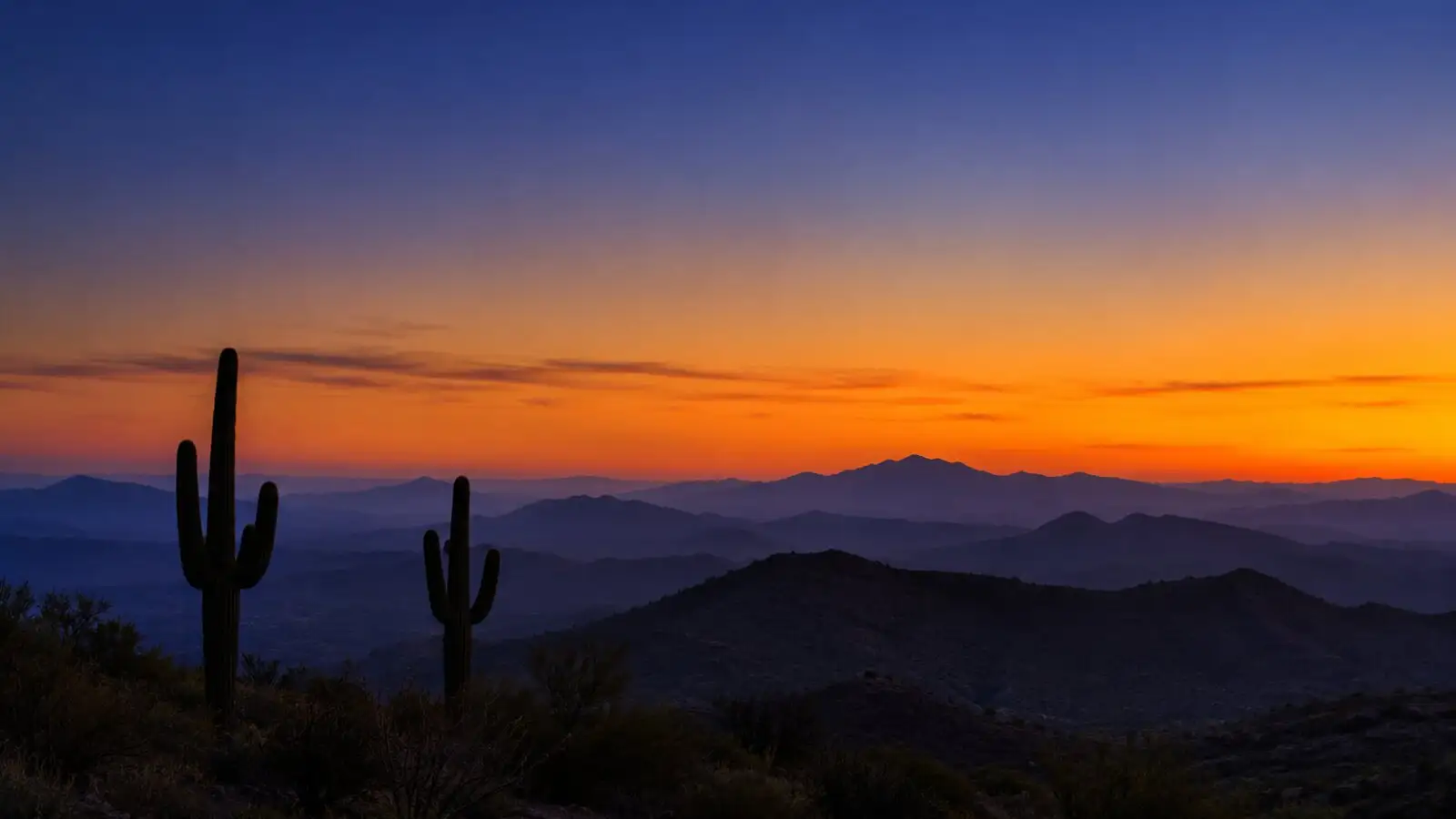
Air conditioning repair Fountain Hills AZ starts with the ground
Fountain Hills was laid out by C. V. Wood for McCulloch Oil in 1970 and incorporated in 1989, covering 20.37 square miles against the McDowell Mountains. The ground runs from 1,798 feet at the fountain to 3,190 feet on the western boundary, and the fountain itself reaches 560 feet with all three pumps running, typically about 300 on two.
Thirty-five percent of the housing here went up in the 1990s and twenty-three percent in the 1980s, much of it on graded hillside lots rather than flat pads. Eighty-three percent of households heat with electricity, the highest share in this coverage area, and barely any home here is manufactured housing.
Who supplies power in Fountain Hills
Fountain Hills sits east of the APS boundary at 128th Street, in Salt River Project territory, and the fuel picture is close to uniform: eighty-three percent electric heat against sixteen percent gas. In practice that means a heat pump does both jobs in most houses, and the heating half of that job is more demanding here than down on the valley floor.
HVAC repair Fountain Hills AZ: what most homes actually run
The town sits roughly 500 feet above Phoenix, and the difference shows on winter nights rather than summer afternoons. Split systems dominate, condensers often sit on a terrace above or below the house they serve, and line sets run further and change elevation more than a flat-lot installation ever asks them to.
What an AC repair Fountain Hills AZ call meets on a hillside lot
A heating season that is actually there
Five hundred feet of elevation over Phoenix does little to the July high and a noticeable amount to the January low. Heat pumps in Fountain Hills spend more hours in heating mode than the same equipment would in Mesa, which puts real wear on the reversing valve and makes the defrost control something that has to work rather than something that rarely gets asked. A system checked only for cooling has been half inspected.
Line sets that climb
On a hillside lot the condenser frequently sits well above or below the indoor equipment, and the refrigerant line set has to handle that vertical run. Oil return to the compressor depends on line sizing and on traps being installed where the design calls for them, and installations that ignored the elevation change show up years later as a compressor that lost lubrication. Replacing equipment on these lots is a design job, not a swap.
Homes empty for part of the year
Around twelve percent of Fountain Hills housing is held for seasonal or occasional use. Those systems shut down for months and then get asked for full output on the first hot day, which is when a marginal capacitor or a stiff contactor finally gives up. A startup check before the season, rather than a service call after the failure, is the difference between a scheduled visit and an emergency one in the middle of a heat warning.
Thirty-year-old ducts in a rebuilt house
A large share of the town was built in the 1980s and 1990s and many of those houses have had two rounds of equipment since. The ducts usually have not been touched. Flexible duct that has spent three decades in an attic loses its insulation value, sags into long low runs that trap condensate, and pulls away at the boot connections, and every one of those faults reads as an underperforming air conditioner.
Elevation runs through all four, and it is the reason AC repair Fountain Hills AZ has a real heating half instead of a nominal one.
Emergency AC repair Fountain Hills AZ: the areas covered
Coverage climbs the town's terraces and washes, taking in the Fountain Park area, Firerock, Eagle Mountain, Sunridge Canyon, Adero Canyon, Crestview, the Shea Boulevard corridor and the Saguaro Boulevard corridor.
ZIP codes: 85268.
Heat pump repair Fountain Hills AZ, replacement and maintenance
- AC Replacement & InstallationReplacing a system that has reached the end of its service life in desert conditions.
- Heat Pump Repair & ServiceThe same box cools in July and heats in January, and it fails differently in each mode.
- AC Maintenance & Pre-Season ServiceCoil cleaning, refrigerant charge and airflow checked before the load arrives, not during it.
- Packaged Rooftop Unit ReplacementOne cabinet on the roof holding the whole system — the Valley's own equipment problem.
AC repair Fountain Hills AZ: common questions
- My condenser is on a slope below the house. Does that matter?
- It matters to the refrigerant piping. When the outdoor unit sits at a different level from the indoor coil, the line set has to carry oil back to the compressor against gravity, which depends on correct line sizing and on traps being fitted where the manufacturer specifies. Installations that treated a hillside lot like a flat one can run for years and then lose a compressor to poor lubrication. Any replacement quote should address the elevation change explicitly.
- How much does the heating side of a heat pump need checking?
- As much as the cooling side, and it usually gets less. A heating-mode inspection covers the reversing valve and its solenoid, the defrost board and sensor, the auxiliary heat strips and their sequencers, and the temperature rise across the indoor coil. None of that is tested by a spring checkup that only measures cooling performance, and in a town where heating actually runs, those are the components that strand a household on a cold morning.
- Can equipment be replaced on a hillside lot without a crane?
- Often yes, but the answer depends on the access rather than on the equipment. Split system condensers can usually be moved by hand or with a dolly where there is a path; a rooftop packaged unit on a hillside house is a different proposition and may need lifting equipment and a road closure. It is a question worth asking during the site visit, because access is a real line in the price and it varies enormously across this town.
- Is Fountain Hills really cooler than Phoenix?
- Somewhat, and the elevation is the reason. The town sits about 500 feet higher than Phoenix, rising from 1,798 feet at the fountain to 3,190 feet along the western boundary near the McDowell Mountains. The effect on a July afternoon is modest (this is still a hot desert climate), but on winter nights it is enough to matter. That is why heating runs more hours here, and why the heating side of a heat pump deserves attention.