
Everything in one cabinet
A split system divides the refrigerant circuit between two boxes and connects them with a line set. A packaged unit does not divide it at all. Compressor, condenser coil, metering device, evaporator coil and blower all sit inside one weatherproof cabinet, and the only things crossing the roof line are the supply and return ducts and the electrical service. There is no line set to size, insulate or trap, and no indoor equipment closet to find space for.
The trade is that the entire system shares one failure surface. A cabinet that has corroded through, a blower housing that has cracked, or a compressor that has gone to ground takes cooling and heating with it in one event. It also means every serviceable component is on the roof, so ordinary diagnosis is a ladder job — which is exactly why homeowners here are so often unaware of the age and condition of their own equipment until it stops.
Where these units are concentrated
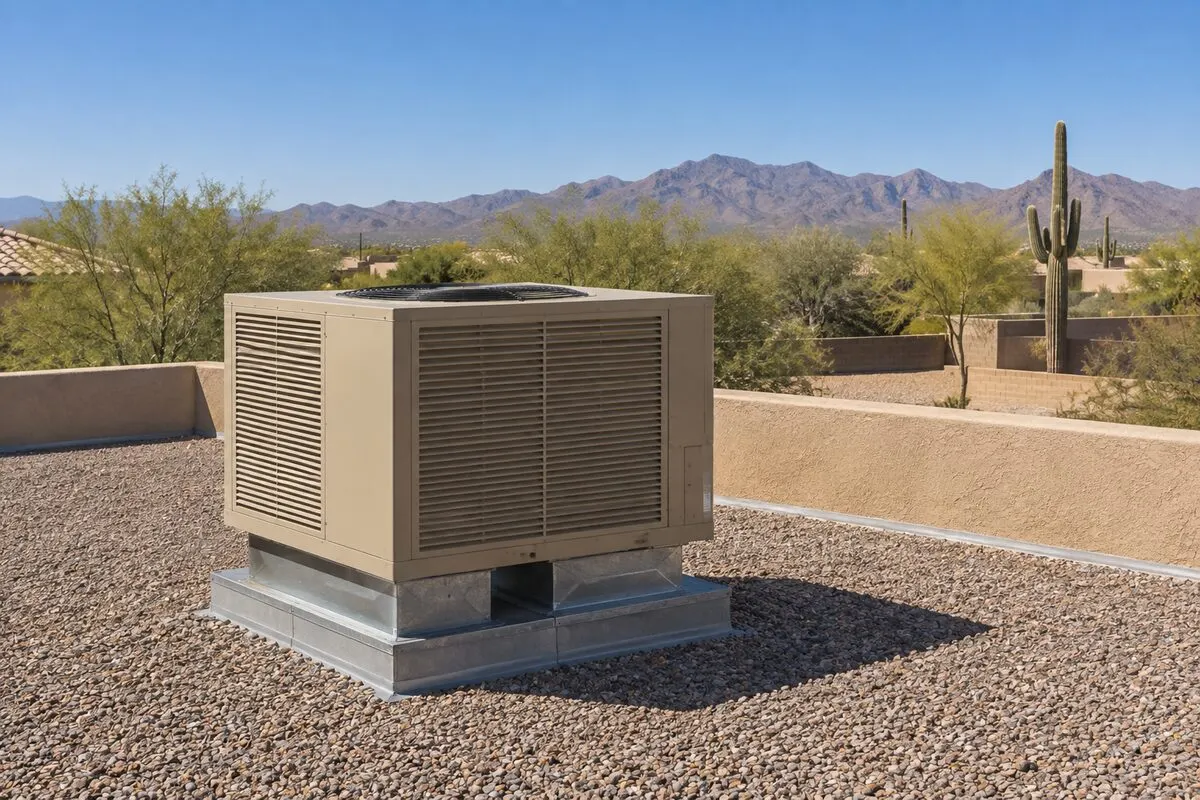
Packaged rooftop unit replacement Mesa AZ work follows the older single-story housing. In Mesa, 29 percent of homes predate 1980 and another 24 percent went up in the 1980s, which is the era when rooftop packages were the regional default. Apache Junction and Sun Lakes carry the same pattern for the same reason: Sun Lakes has a median build year of 1991 and is almost entirely single-story. The newer subdivisions in Gilbert, Queen Creek and San Tan Valley were built after the split system took over and rarely have a cabinet on the roof at all.
Rooftop AC replacement Mesa AZ: what a change-out involves
Access and lifting
The old cabinet has to come off and a new one has to go up. On an accessible single-story roof with street frontage this can be routine; on a hillside lot in Fountain Hills, a gated street in Sun Lakes, or a property with restricted approach it means a crane and a scheduling window. Access is a real line in the price and it varies more between houses than the equipment does.
The curb and flashing under the cabinet
The unit sits on a curb, and the flashing around that curb has been doing roofing work for as long as the unit has been doing mechanical work. When a twenty-year-old cabinet comes off, what is underneath it becomes visible for the first time. Deteriorated flashing, a soft deck or a curb that no longer matches modern cabinet dimensions are common findings, and they are far cheaper to plan for than to discover.
Duct transitions
Supply and return openings were cut for the footprint of the original unit. Cabinet dimensions have changed over the decades, so a new unit frequently needs transition ductwork to meet the existing openings. Done properly it is invisible; done badly it introduces a restriction directly at the equipment, and the new system never delivers what its label says because the air side is choking it at the first bend.
Electrical and controls
Disconnect, breaker sizing and conductor rating all have to suit the new equipment rather than the old, and a rooftop disconnect that has spent two decades in the sun is usually replaced alongside the unit. Where the old cabinet used a simple thermostat and the new one expects a communicating control, the low-voltage wiring may need conductors the existing run does not have.
Gas pack or heat pump package
Packaged units come in both forms. A heat pump package reverses its refrigerant circuit for heating and falls back on electric strips when it needs help; a gas pack has a burner section and a flue. In this coverage area the electric version dominates, because the housing dominates: 76.5 percent of Mesa households and 82.7 percent of Apache Junction households heat with electricity. Where a gas pack is already installed, replacing like with like keeps the gas piping and flue arrangement intact and is usually the simpler path.
What to establish before signing
A packaged rooftop unit replacement Mesa AZ quote covers more than the cabinet, and these are the parts of it that get missed.
- Model numbers for the proposed unit and confirmation that it fits the existing curb
- Who is responsible for the flashing and roof surface around the curb, and what happens if the deck is soft
- How the unit is being lifted, and whether that cost is inside the quote
- Whether transition ductwork is included and how the openings will be sealed
- Heating type — heat pump with strips, or gas — and why that choice was made
- Commissioning readings handed over on completion
Rooftop package work by city
- AC Repair in Mesa
- AC Repair in Gilbert
- AC Repair in Chandler
- AC Repair in San Tan Valley
- AC Repair in Queen Creek
- AC Repair in Apache Junction
- AC Repair in Fountain Hills
- AC Repair in Sun Lakes
- AC Repair in Gold Canyon
Packaged rooftop unit replacement Mesa AZ: common questions
- Why is the air conditioner on the roof in the first place?
- Because of how the houses were built. Older Valley homes sit on a slab with no basement and are usually single-story, so there is no interior space designed to hold an air handler and no reason to give up yard area to a condenser. Putting the entire system in one cabinet on the roof shortens the duct runs, keeps the equipment out of the way and leaves the patio and side yard usable. It has been the regional default for decades.
- Does a packaged unit have to be replaced with another packaged unit?
- Almost always, yes. The supply and return openings are cut through the ceiling to meet a specific cabinet footprint sitting on a specific curb. Converting to a split system means finding indoor space for an air handler, running a new refrigerant line set, reworking those duct transitions and closing up the roof where the old unit sat. It is occasionally the right call on a house that has changed substantially, and rarely the cheaper one.
- Is a crane always needed?
- Not always. Smaller residential cabinets on accessible single-story roofs are sometimes handled with a boom truck or, on the right property, by hand equipment. Larger units, restricted access, hillside lots and gated communities with limited street width push the job toward a crane, and that changes both price and scheduling. It is a question worth settling during the site visit rather than discovering on the morning of the change-out.
- What is a gas pack, and do I have one?
- A gas pack is a packaged unit whose heating section burns natural gas rather than using a heat pump or electric strips. In this coverage area they are the minority: Mesa heats 76.5 percent electrically and Apache Junction 82.7 percent, so most rooftop cabinets here heat electrically. The rating plate on the unit settles it, and it matters for replacement because the gas line, the flue arrangement and the cabinet dimensions all differ.