
Why the East Valley runs on heat pumps
Heating fuel here is electricity, not gas, across most of the older housing. Census figures put Mesa at 76.5 percent of households heating electrically, Apache Junction at 82.7 percent and Fountain Hills at 82.9 percent. Those are not homes with electric furnaces. They are homes where the air conditioner runs backwards in winter. The picture reverses only in the newest suburbs: Queen Creek heats 61.9 percent by natural gas because it was built after the gas mains arrived.
That distribution is what makes heat pump repair Mesa AZ year-round work rather than a summer trade. In a gas-heated house a failed compressor is a summer problem; in an electrically heated East Valley house it is a problem in both seasons, and a system limping through January on auxiliary strips is quietly spending far more than it should while nobody notices anything wrong in the rooms.
One circuit, two directions
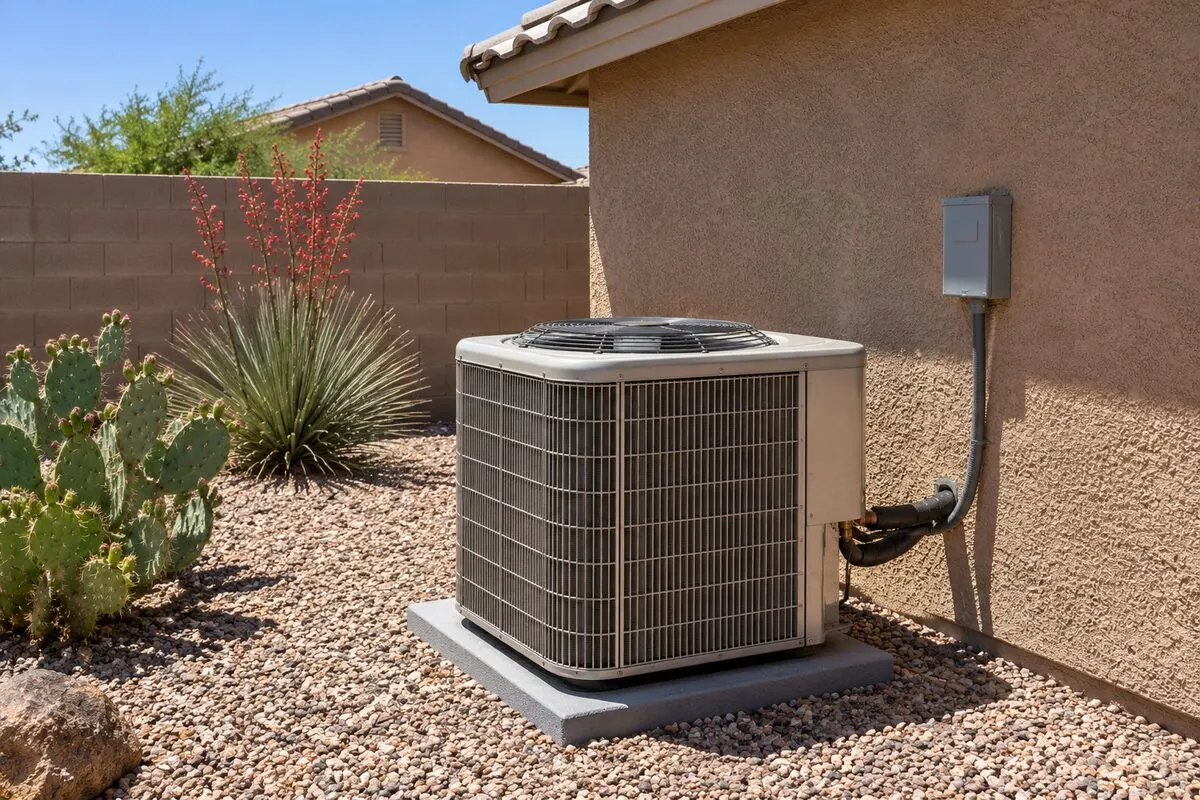
Heat pump repair in cooling mode
Electrical parts, first and most often
Run capacitors lose capacitance gradually and then fail to start the compressor, usually on the hottest afternoon of the week. Contactor points pit and weld. Condenser fan motors seize after years of bearing wear in dust and heat. These are the majority of summer calls in this climate, and they are hour-long repairs on equipment of any age.
Charge and coil condition
A system low on refrigerant cools weakly and can ice the indoor coil, which then looks like an airflow problem. A condenser matted with monsoon dust raises head pressure until the system trips its own high-pressure switch. Superheat and subcooling readings tell these apart, and a technician who tops up refrigerant without finding the leak has sold you the same visit again next year.
Heating repair Mesa AZ: what fails in heating mode
The reversing valve and its solenoid
The valve that flips the circuit is the one component a cooling-only system does not have, and it is the one a spring checkup never tests. A valve that sticks part-way leaves the system moving heat in neither direction properly; a failed solenoid coil leaves it stuck in cooling while the thermostat calls for heat. Both present as a house that will not warm up while the equipment appears to run normally.
Defrost control and auxiliary strips
Even in the Valley a heat pump can frost its outdoor coil on a cold morning, and the defrost board and sensor exist to clear it. When that control fails the system either never defrosts, losing capacity, or defrosts constantly, wasting it. Alongside it sit the auxiliary heat strips and their sequencers, which are the components that turn a minor fault into a large electricity bill.
The bill as a diagnostic
A heat pump moves several units of heat for every unit of electricity it consumes. Resistance strips deliver one for one. When a fault pushes the system onto strips — a low charge, a stuck reversing valve, a thermostat left in emergency heat — the house stays comfortable and nothing sounds wrong, so the first evidence is a January statement two or three times the usual size. If the bill jumped and the rooms feel fine, the system is worth looking at rather than the tariff.
Higher ground, longer heating season
The heating half of the year is not identical across the coverage area. Fountain Hills sits around 500 feet above Phoenix, rising to 3,190 feet on its western boundary, and Gold Canyon stands at 1,913 feet. Heat pumps in both towns spend measurably more hours in heating mode than the same equipment in Mesa or Chandler, which puts real duty on the reversing valve and the defrost control rather than theoretical duty. A heating-mode inspection in autumn is worth more in those two towns than anywhere else here, and it is the half of heat pump repair Mesa AZ that most often gets skipped.
Heat pump service by city
- AC Repair in Mesa
- AC Repair in Gilbert
- AC Repair in Chandler
- AC Repair in San Tan Valley
- AC Repair in Queen Creek
- AC Repair in Apache Junction
- AC Repair in Fountain Hills
- AC Repair in Sun Lakes
- AC Repair in Gold Canyon
Heat pump repair Mesa AZ: common questions
- How is a heat pump different from an air conditioner?
- Mechanically it is the same machine with one extra component. A reversing valve lets the refrigerant circuit run backwards, so the coil that rejects heat outdoors in summer absorbs it in winter and the indoor coil does the opposite. Everything else — compressor, coils, blower, metering device — is shared. That is why a compressor failure takes out both seasons at once and why a heating fault can exist in a system that cooled perfectly all summer.
- Why is my heat pump blowing cool air in heating mode?
- Heat pump supply air is genuinely cooler than furnace air, often in the mid nineties rather than well over a hundred, so it can feel wrong while being normal. What is not normal is air that is cooler than the room. That points at the reversing valve failing to shift, a refrigerant charge too low to move heat, a defrost cycle stuck on, or the system running on auxiliary strips only while the compressor sits idle.
- What is auxiliary heat and why does it cost so much?
- Auxiliary heat is a bank of electric resistance strips in the air handler, used when the heat pump cannot keep up or during defrost. Resistance heating converts electricity to warmth at a fixed one-to-one rate, while a heat pump moves several units of heat for every unit of electricity. When a fault forces the system onto strips, the house stays comfortable and the bill rises sharply, which is often the first symptom a household actually notices.
- Does a heat pump need servicing twice a year?
- It benefits from it more than a cooling-only system does, because half its components are only exercised in one mode. A spring visit covers the cooling side: charge, condenser coil, capacitor, airflow. An autumn visit covers what the spring visit never touches: the reversing valve and its solenoid, the defrost board and sensor, the auxiliary strips and their sequencers, and the temperature rise across the indoor coil in heating.